
Universal Design for Learning (UDL) is something I now feel deeply aligned with, both professionally and personally. But I didn’t always design with UDL at the heart of my learning design.
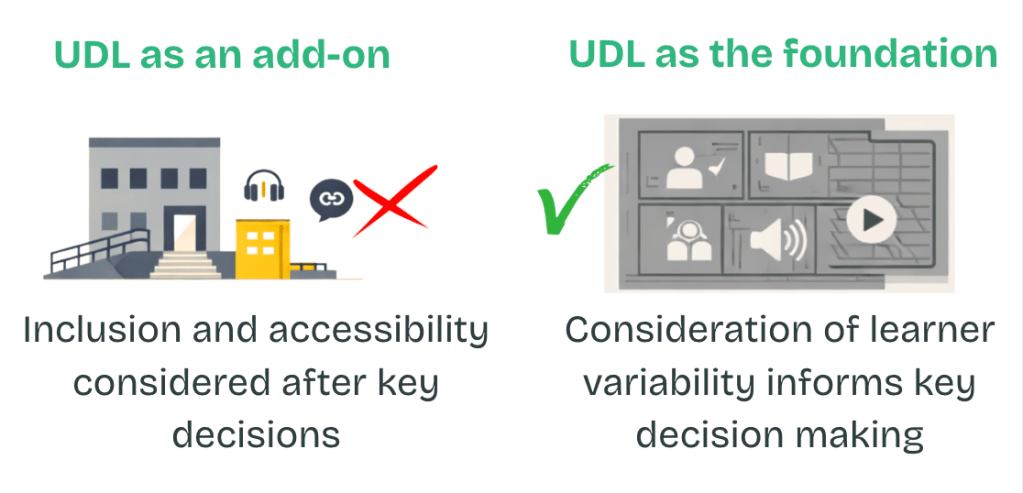
During my Work Integrated Learning (WIL) project, where I was developing a Learning Design Portfolio Guide, I initially treated UDL as something to layer in at the end to “make sure it’s accessible”.
This article is a reflection on what happened when I did that, what I learned, and how it fundamentally changed how I now approach learning design.
The Starting Point: A Well-Intentioned but Incomplete Approach
At the beginning of the project, my focus was on:
- Meeting the brief to design a portfolio creation guide
- Creating something practical and useful
- Managing scope and time constraints
Accessibility and inclusion were always important to me, but in practice, they sat slightly to the side of my design decisions rather than at the centre.
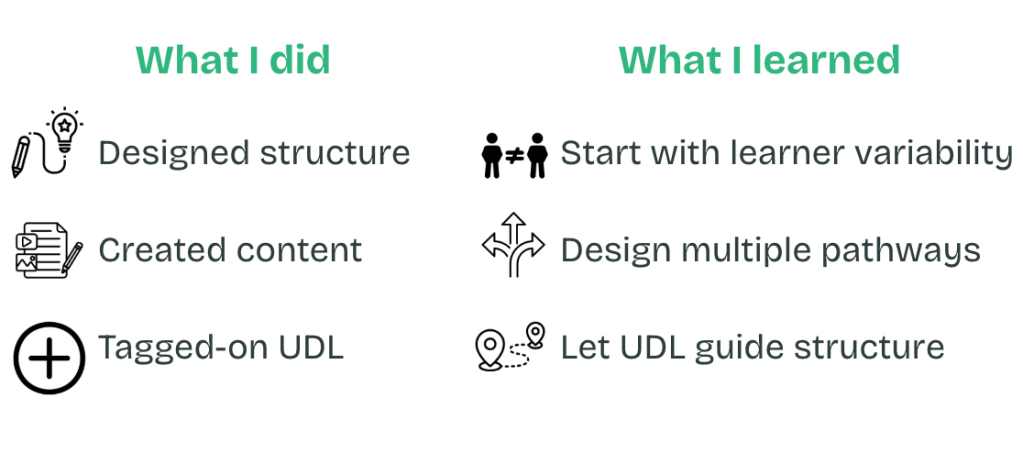
I designed the structure first, the content second, and then worked on making it more inclusive.
Essentially, I worked in the reverse approach to what I should’ve done.
What I Actually Did
As the project progressed, I began layering in UDL considerations:
- Adding captions and transcripts
- Simplifying navigation
- Offering choice in how learners could engage
- Reducing cognitive load through chunking
While these changes absolutely improved the resource, it occurred to me that I was retrofitting and making each adjustment feel like a workaround rather than a natural part of the design.
The Moment It Clicked
The turning point came during reflection and feedback from my supervisor.
I realised that when UDL is treated as an add-on:
- Decisions feel constrained, burdensome and awkward
- Design choices become compromised
- Inclusion becomes reactive rather than intentional
UDL isn’t meant to fix a design.
It’s meant to shape it from the start.
Once I reframed UDL as the foundation, everything shifted.
What I Would Do Differently Next Time
If I were to redesign this project from scratch, I would:
- Begin with learner variability as the starting point
- Design multiple pathways before finalising content
- Let UDL guide the entire structure of the design, not just the delivery
- Ask “Who might this exclude and how can I include them?” at every design stage
This approach doesn’t add more time and energy in the long run.
It actually reduces unnecessary work later.
Why This Matters Beyond This Project
This experience reinforced something I now strongly believe that inclusive design is not about doing more – it’s about doing things differently from the beginning.
Whether designing for students, educators, or workplaces, UDL offers a way to:
- Anticipate barriers
- Support autonomy
- Incorporate different ways of learning and engaging
UDL is effective and inclusive design, and a fundamental human right.
Key Takeaways
- UDL works best when it is the starting point, not the finishing touch
- Retrofitting inclusion is harder than designing for it
- Reflection is where real learning design growth happens
- Designing for variability benefits all learners, not just some
This project didn’t just help me build a portfolio guide.
It led to deep refection and reshaped how I think about learning design.
 Annelise Dixon