
Learning design is often discussed in terms of outcomes, engagement and performance. While these matter, they are only part of the picture. At its core, learning design is an act of care.
Every design decision sends a message to learners about whether they are seen, supported, and respected. The structure, language, pacing, and flexibility of a learning experience all shape how safe learners feel to participate and grow.
When learning is designed with care, it creates the conditions for meaningful engagement. When care is lacking, learning can quickly become overwhelming and the carelessness can even be harmful.
Care Begins Before Content
Care in learning design starts long before content is created.
It begins with understanding who learners are and what they are carrying into the learning space. Many learners are balancing work, family responsibilities, health concerns, financial pressure, and past experiences of education that may not have been positive.
Designing with care means asking:
- What assumptions am I making about time, energy, and prior knowledge?
- How clear are my expectations and instructions?
- Where might learners experience unnecessary cognitive or emotional load?
These questions shift learning design from delivery to responsibility.
Cognitive Load is a Wellbeing Issue
Cognitive load is often framed as a technical design concern. In reality, it is deeply connected to learner wellbeing.
Overly complex navigation, dense instructions, unclear tasks, or competing information can quickly lead to frustration, anxiety, and disengagement. For neurodivergent learners, learners with disabilities, or those experiencing stress, this load is often amplified.
Designing with care means:
- prioritising clarity over unnecessary complexity
- sequencing information intentionally and logically
- providing multiple ways to access and engage with content
When cognitive load is managed thoughtfully, learners are better able to focus on learning rather than on decoding the learning environment itself. This is a design responsibility rather than a learner deficit.
Inclusion is an Expression of Care
Inclusive learning design is not an additional layer added at the end of a project. It is an expression of care woven throughout the design process.
Care shows up in:
- flexible pathways and choice
- accessible formats and plain language
- explicit guidance rather than hidden expectations
- opportunities for learners to engage in ways that suit their strengths
When inclusion is embedded from the beginning, learners do not need to ask for accommodations in order to participate fully. They are already considered.
This understanding later deepened for me during my reflection on Universal Design for Learning, where I recognised the difference between retrofitting inclusion and designing for learner variability from the outset.
Designing for Real People
Learning does not happen in ideal conditions.
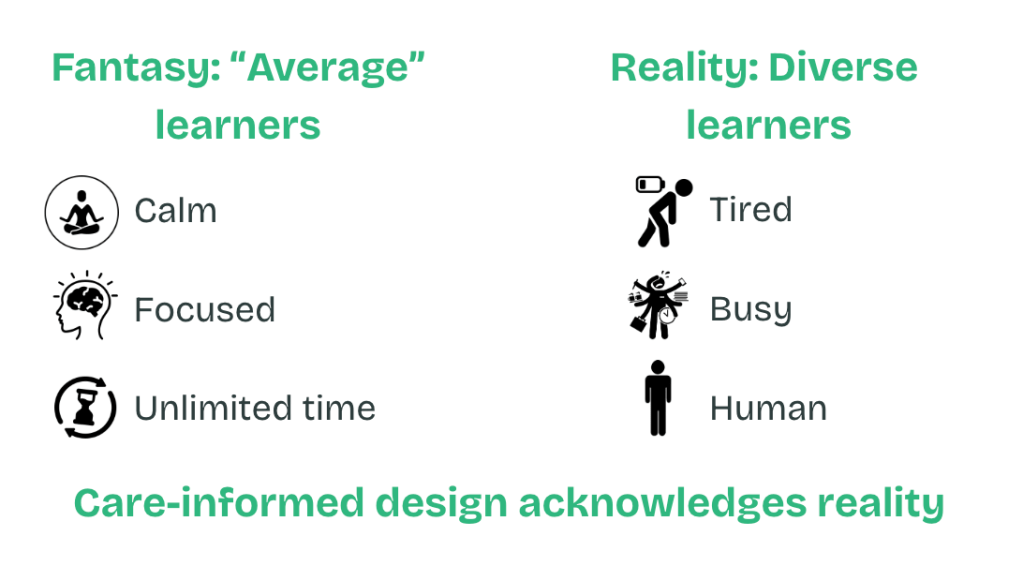
People arrive tired, distracted, uncertain, or lacking confidence. Designing for real people means acknowledging this reality rather than designing for an imagined “average” learner.
Care-informed learning design recognises that:
- motivation fluctuates
- energy levels vary
- confidence is built through small, achievable successes
- psychological safety supports risk-taking and growth
Designing with care means creating learning experiences that are both supportive and rigorous.
Why Learning Design as Care Matters
When learning design centres care, the impact extends beyond knowledge acquisition.
Learners are more likely to:
- feel capable and confident
- persist through challenge
- engage more deeply and meaningfully
- carry learning into practice
Care removes unnecessary barriers so that learners can meet high standards. does not lower standards.
A Closing Reflection
Learning design is never neutral. Every choice either opens a door or places an obstacle in the way.
Designing learning as an act of care means choosing clarity, flexibility, and inclusion with intention. It means recognising the humanity of learners and designing in ways that honour their time, effort, and lived experience.
This is not just good learning design.
It is responsible learning design.
Reflection Prompts for Designers and Educators
- Where might learners experience unnecessary friction in your learning designs?
- How do your design choices communicate care, or lack of it?
- What would change if wellbeing was treated as a design consideration rather than a separate initiative?
 Annelise Dixon