
Motivation is often blamed when learning doesn’t “stick”.
Even with careful planning, good intentions, effort and high quality content, there can still be failure to create real change.
The barrier faced by many educators is that learning has been designed around content, not around how people actually think, feel, and learn.
Learning happens in busy workplaces, where tiredness, stress and the complexities of human life create barriers to effective educational outcomes.
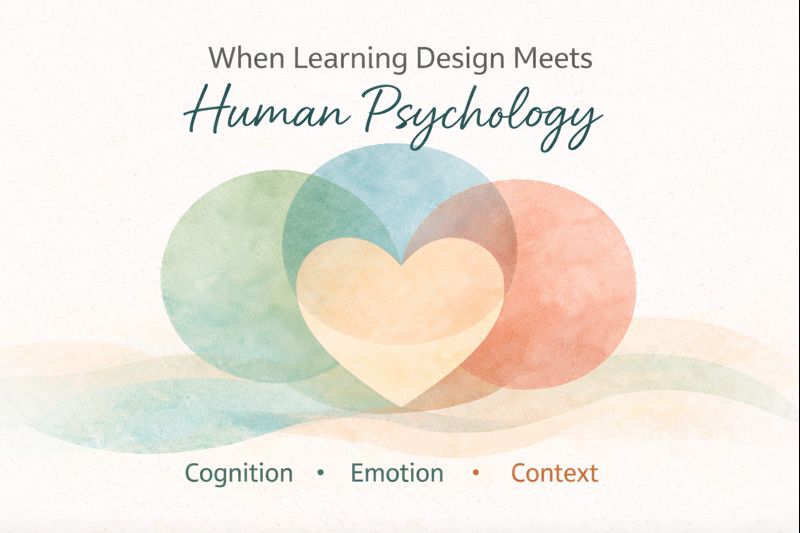
This article explores what happens when learning design aligns with human psychology, including improvements in engagement, confidence and application in real world contexts.
Learner-centred design is a response to how humans actually learn
Dr David Rock’s work in applied neuroscience, including his AGES model, highlights a few consistent conditions that support learning:
- Attention – what learners notice and focus on
- Generation – opportunities to actively make meaning, not just receive information
- Emotion – how learners feel during the learning experience
- Spacing – when and how learning is revisited over time
Compare these two approaches:
- A one-off training session packed with information
- Short learning moments that invite discussion, reflection, and application over time
The key difference is whether learners are active participants and constructors of knowledge, or passive recipients.
Learner-centred design intentionally reduces cognitive overload, invites curiosity and participation, and creates space for learners to connect ideas to their own context. This creates learning opportunities that focus on applicable and relevant experiences rather than taking a purely theoretical focus.
Emotion, attention and memory are deeply connected
Emotion plays a significant role in how information is processed, remembered, and understood.
When learners feel curious, they are more likely to pay attention, engage more deeply, retain information, and transfer learning into practice.
On the other hand, when learning experiences trigger stress, overwhelm, or disengagement, cognitive resources are diverted away from learning. With a high emotional load, even well-designed and rich content can be difficult to absorb.
This is particularly relevant in workplaces and educational settings where learners may already be managing competing demands, time pressure, or emotional fatigue.
Learning does not happen in neutral emotional states
Emotions influence what we notice, prioritise, remember, and how we construct meaning from content and learning experiences.
Designing learning without considering emotional engagement risks overlooking how simple design choices can make a meaningful difference. This can be addressed by framing learning around real challenges rather than abstract concepts, using questions and scenarios to spark curiosity, and normalising uncertainty and challenge as part of the learning process.
These approaches support attention and memory by creating conditions where learners feel psychologically safe enough to engage.
Encouraging learners to reflect on how their emotional state shifts throughout the day can also support learning. When do you feel most focused? When does learning feel harder? How do physical states such as fatigue, stress, or calm influence decisions and capacity to engage?
Building awareness of these patterns can provide valuable insight into effective and meaningful learning.
Designing learning that works in the real world
Learning design happens in busy workplaces and learning environments where people are managing competing priorities, emotional load, and limited time and energy. Our focus should be on designing more intentionally.
When learning aligns with how people actually think, feel, and engage, it becomes easier to participate in experiences, retain learning, and apply new skills and knowledge. Small, thoughtful design choices can reduce cognitive and emotional load, support confidence, and create learning experiences that feel relevant rather than overwhelming.
Learning that respects human psychology is more effective, more enjoyable, and more impactful.
As you design or facilitate learning, consider:
- Where does this learning invite attention and curiosity?
- How does it support emotional engagement and psychological safety?
- What opportunities exist for learners to actively make meaning, practise, and revisit ideas over time?
Practice Checklist
I’ve created a short practice checklist that translates these ideas into practical design considerations.
It’s designed for educators, learning designers, and leaders who want learning to be more engaging, relevant, and likely to transfer into real-world practice.
Download the Practice Checklist from Canva by clicking here
 Annelise Dixon